

Generator Repair & Maintenance

Service for the Backup Power System You Already Own
Generator Repair & Maintenance in Santa Clara, CA
When your backup generator will not start, shuts down unexpectedly, or runs without powering the property, EJ Home Services can help evaluate what is happening. Our generator repair and maintenance service in Santa Clara begins with diagnosis, followed by recommendations suited to the equipment and the problem.
We help homeowners and appropriate commercial customers assess existing generator systems and their electrical connections. Share the manufacturer, model, and symptoms so the team can confirm service compatibility and current scheduling options.

Illustrative service scene. Equipment and access vary by property.
Generator Repair in Santa Clara
Backup power depends on more than an engine starting. The generator must operate consistently, produce usable electrical power, work with the transfer equipment, and safely supply the circuits it was designed to support. A fault anywhere along that path can leave the property without expected power.
Starting systems, batteries, wiring connections, controls, sensors, fuel-related components, and associated electrical equipment can contribute to a failure. EJ evaluates the symptoms before recommending a repair. Our broader electrical services support related concerns discovered during that assessment.
Signs Your Generator May Need Repair
Generator Won’t Start
A no-start condition can involve a battery, starting circuit, controls, a protective shutdown, fuel-related conditions, or a maintenance issue. Whether the unit fails to crank or cranks without starting is useful information to report. Neither symptom establishes a diagnosis on its own.
Generator Starts and Shuts Down
Unexpected shutdowns may reflect protection systems responding to a fault, operating conditions, electrical issues, fuel-related problems, or overdue maintenance. Note when it stops and any displayed message. Do not repeatedly restart equipment that is reporting a fault.
Generator Runs but the Property Has No Power
A running generator can still have an output, control, connection, breaker, or transfer-equipment problem. The electrician needs to establish where power is being interrupted instead of assuming the engine is the source of the failure.
Failed Automatic Exercise Cycle
Many standby systems perform programmed exercise or self-test cycles. If the expected cycle does not occur or ends abnormally, the settings, battery, controller, and operating conditions may need evaluation. The expected schedule depends on the manufacturer and configuration.
Warning Lights or Fault Codes
Record the exact message or code if it can be read safely without opening equipment. Its meaning depends on the manufacturer and model. A code helps guide diagnosis; it does not always identify a single part that needs replacement.
Unusual Noise or Vibration
A change from normal operation deserves attention, especially when accompanied by shutdowns, odors, or warnings. Avoid continued operation contrary to the owner’s manual. Electrical and mechanical causes need to be distinguished before the next step is chosen.
Battery Problems, Corrosion, or Visible Damage
A weak starting battery, charging concern, corroded connection, damaged wiring, or loose component can affect reliability. Request an inspection or ask whether generator battery replacement is appropriate for your model. Do not reach into the enclosure or tighten electrical connections yourself.
How EJ Diagnoses Generator Problems
The first question is when the failure occurs: during startup, while running, during transfer, or when a particular load is connected. Your observations and service records help separate an intermittent problem from a condition that occurs every time.
- Review the history. Discuss symptoms, recent outages, service history, warning indicators, and changes in the property’s electrical loads.
- Assess the relevant equipment. Where appropriate, evaluate accessible electrical connections, visible condition, associated breakers, controls, and the battery or starting system.
- Check the power path. Evaluate transfer equipment and relevant electrical conditions. Operational testing is performed only when safe and appropriate for the system.
- Explain the next step. Findings may support a targeted repair, manufacturer-directed maintenance, a separate equipment specialist, or a replacement discussion.
A generator electrician must also consider the building’s existing electrical system. If a fault extends beyond the generator, EJ’s electrical repair and troubleshooting service can address the relevant scope.
Generator and Transfer Switch Problems
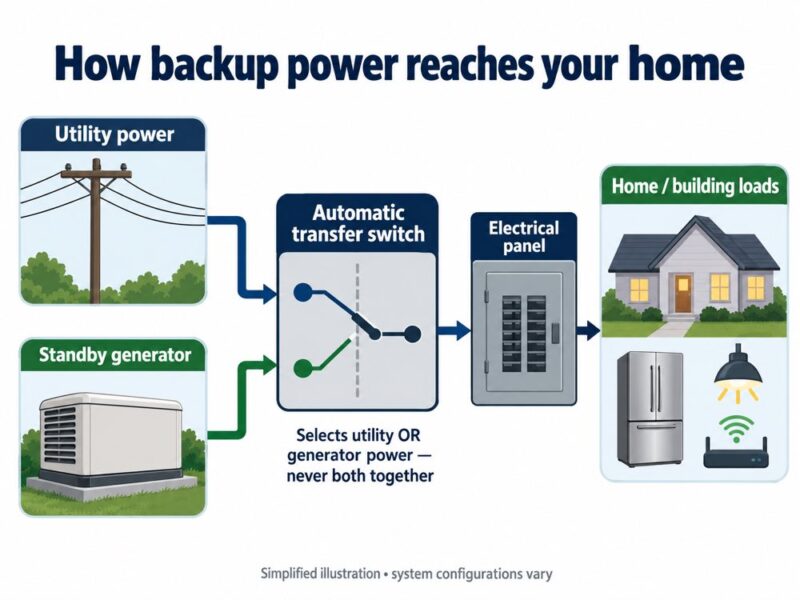
A standby generator typically works with transfer equipment that changes the building’s supply between utility and generator power. Starting the generator and transferring the load are different functions. Both need to work correctly for backup power to reach the intended circuits.
- The generator starts during an outage, but the building remains without backup power.
- The system does not respond as expected when utility power fails.
- Transfer does not occur, or transfer-related warnings appear.
- The property remains on generator power after utility service returns.
These symptoms can involve sensing, controls, connections, switching equipment, or generator output. A professional should assess the complete sequence rather than replace the transfer switch based on the symptom alone.

Illustrative electrical inspection. Service items depend on the model.
Generator Maintenance in Santa Clara
Periodic generator maintenance provides an opportunity to identify developing issues before an outage. Relevant electrical checks may include battery condition, accessible connections, wiring, visible corrosion, controller warnings, and appropriate exercise or operational evaluation.
Maintenance requirements vary by generator type and manufacturer. EJ can evaluate the system and determine what electrical or generator service is appropriate. Confirm the scope for your equipment before the visit, including whether the requested work involves electrical diagnosis or equipment-specific mechanical service.
The owner’s manual may specify oil, filters, spark plugs, belts, hoses, coolant, and other service items when applicable. Those requirements do not mean every generator needs every item, or that every mechanical procedure is included in an EJ visit.
Planning Your Generator Service Schedule
Use the manufacturer’s recommendations for the actual model and its operating hours. Fuel type, usage, environmental conditions, age, and previous service history can affect the plan. There is no single interval that fits every standby or portable generator.
Extended operation, repeated outages, starting trouble, a failed exercise cycle, new warnings, or unusual operation can justify evaluation before the next scheduled visit. Keep the manual and service records available so recommendations reflect how the equipment has been used.
Home Generator Repair
Residential backup systems may support refrigeration, lighting, communications, HVAC equipment, or selected essential circuits. Some are designed for broader home loads. Capacity and circuit selection depend on the generator sizing, transfer arrangement, and electrical design; every appliance is not automatically covered.
Home generator repair should consider what the system was intended to power and whether those needs have changed. Tell EJ if trouble occurs only when a particular appliance starts. Homes using medical or accessibility equipment should confirm compatibility and maintain an appropriate contingency plan rather than assume any generator guarantees uninterrupted operation.
Where the concern involves building distribution, an assessment of the electrical panel may be relevant. Repeated trips may also require circuit-breaker diagnosis; resetting a breaker repeatedly does not resolve the cause.
Commercial Generator Repair
Offices, retail spaces, property-managed buildings, and light-commercial facilities may rely on backup lighting, communication systems, refrigeration, or operational equipment. Diagnosis needs to account for the loads involved, the effect of interruption, and access to the generator and transfer equipment.
When requesting commercial generator repair, provide the system size, manufacturer, model, configuration, and property use. Equipment and project scope determine whether the work fits EJ’s service capabilities. Coordinate any planned testing or interruption with the people responsible for the building. EJ’s commercial electrical services cover related business electrical needs.
Generator Repair vs. Replacement
Not every generator failure calls for a new system. A professional evaluation should consider the actual fault, overall condition, repair history, parts availability, and the property’s backup-power needs.
When Repair May Make Sense
- The fault is isolated and can be addressed appropriately.
- Compatible replacement parts are available.
- Major components remain serviceable.
- The system still meets the property’s intended loads.
When Replacement Deserves a Look
- Failures recur or major components have deteriorated.
- Parts are unavailable or difficult to obtain.
- Repair costs are impractical relative to system condition.
- The equipment is outdated or no longer meets power needs.
Age is one factor, not a universal replacement cutoff. If the evaluation points toward a new system, EJ’s generator installation page explains that separate service.
Standby and Portable Generator Service
Permanently installed standby generators can be integrated with transfer equipment to support designated building loads. Their electrical connections, controls, and transfer operation need to be considered together when troubleshooting a loss of backup power.
Portable generators have different operating and connection requirements. Supplying household wiring requires properly designed connections and approved transfer or interlock equipment, as applicable. Contact EJ with the model and problem to confirm whether the requested electrical service fits; portable-engine repairs and overhauls require separate scope confirmation.
Manufacturer and model compatibility matter for every system. Share that information when booking, along with any fault code. Service capabilities should be confirmed for the particular equipment and work required.
Generator Safety Comes First
- Leave energized panels, generator electrical compartments, and transfer-switch equipment closed.
- Do not bypass safety devices or connect a generator directly to household wiring without approved transfer equipment.
- Never use a portable generator indoors, in a garage, or in an enclosed space, even with doors open. Follow manufacturer placement and operating instructions.
- Keep portable generator exhaust away from windows, doors, and vents. Maintain working carbon monoxide alarms as directed by their manufacturer.
- Do not operate damaged equipment or equipment contrary to its manual.
The CDC’s carbon monoxide guidance explains the hazards of generator exhaust. For smoke, active sparking, electrical injury, a carbon monoxide alarm, or immediate danger, move people to safety and contact emergency services. For an urgent electrical concern without immediate danger, contact EJ’s emergency electrician service to describe the situation and confirm availability.
Why Choose EJ Home Services?
EJ Home Services is based in Santa Clara and serves Silicon Valley with plumbing and electrical services. The company’s website highlights more than 20 years of experience, family ownership and operation, and contractor license number 826797.
For generator service, a useful first step is a clear account of what failed and an evaluation of the relevant electrical system. EJ can discuss the findings and appropriate options, with compatibility and service scope confirmed for your generator. Have the model information, symptoms, and available service records ready when you contact the team.
What Local Customers Say About EJ
EJ Home Services has a 4.9 out of 5 Google rating from 3,884 reviews, checked October 28, 2026. These are company-wide reviews across EJ’s services, rather than reviews solely of generator repair. Read reviews on Google.


Generator Repair & Maintenance FAQs
Why won’t my generator start?
A weak battery is one possibility, but controls, settings, maintenance needs, fuel-related conditions, and other faults can also prevent startup. Note any warning message and when the problem began. A professional needs to identify the cause before a battery or another part is replaced.
Why does my generator start but not power my home?
The problem may involve generator output, a breaker, electrical connections, controls, or transfer equipment. A running engine does not confirm that usable power is reaching the intended circuits. Leave electrical enclosures closed and arrange professional diagnosis.
How often should a home generator be serviced?
Follow the maintenance schedule for your manufacturer and model. Operating hours, fuel type, usage, environmental conditions, age, and service history also matter. Extended operation, repeated outages, a failed exercise cycle, warning codes, or unusual operation can call for evaluation before the next scheduled service.
Can an electrician repair a standby generator?
An electrician can evaluate the electrical portions of a standby generator system, its connections, and associated transfer equipment. Generator systems also contain equipment-specific controls and mechanical components. The issue, manufacturer, model, and required work determine the appropriate service scope; confirm compatibility with EJ when scheduling.
What does generator maintenance include?
Maintenance can include an assessment of battery condition, accessible electrical connections, corrosion, wiring, controller warnings, and operation. Manufacturer instructions may also require oil, filters, spark plugs, belts, hoses, coolant, or other mechanical service, depending on the model. Confirm which items EJ can perform for your particular equipment before booking.
What are signs my generator needs repair?
Starting trouble, unexpected shutdowns, a failed exercise cycle, warning codes, unusual noise or vibration, battery problems, visible damage, corrosion, or running without supplying expected power warrant evaluation. These signs can have different causes and do not establish which component has failed.
Should I repair or replace an older generator?
Consider the diagnosed fault, availability of parts, condition of major components, repair history, repair cost, and whether the system still meets the property’s needs. An isolated repair may be practical, while recurring failures or deteriorated components may justify replacement. Age alone does not determine the answer.
Can EJ repair commercial generators?
Contact EJ with the manufacturer, model, system size, configuration, property use, and symptoms. Commercial generator repair compatibility depends on the equipment and project scope. EJ can determine whether the requested electrical or generator service fits its capabilities before work is arranged.
What is an automatic transfer switch?
An automatic transfer switch coordinates the building’s connection to utility or generator power and changes the supply when the system is designed to do so. Proper transfer equipment keeps the two sources from being connected together unintentionally. Its controls and switching equipment require professional service.
Why isn’t my generator exercising automatically?
Settings, battery condition, controls, an active fault, or another operating condition may interrupt an expected exercise cycle. Exercise schedules vary by manufacturer and configuration. Record what the controller displays and arrange evaluation rather than bypassing a protection device or repeatedly forcing startup.

Make Us Your Top Choice
 Fast Response Time
Request Generator Repair or Maintenance
Tell EJ Home Services what your generator is doing, when the problem occurs, and which manufacturer and model you own. The team can confirm service compatibility and discuss scheduling in Santa Clara and nearby communities.