

Water Softener Installation

Whole-Home Hard Water Treatment Starts with the Right Installation
Water Softener Installation in Santa Clara, CA
If mineral buildup, spotting, or soap residue has you considering a home water softener, start with an assessment of your water and plumbing. EJ Home Services provides professional water softener installation in Santa Clara, CA and surrounding areas, with installation planning based on the needs of the household.
The right system depends on water use, hardness, equipment capacity, available space, plumbing configuration, drainage, and any electrical requirements. EJ can review the proposed installation before equipment recommendations or connection details are finalized.

Illustrative installation scene. Equipment and plumbing arrangements vary.
What a Water Softener Does
A conventional water softener primarily reduces hardness minerals such as calcium and magnesium. Treating hardness can help limit new mineral scale and residue on fixtures and in equipment that uses the treated water. It does not restore damaged pipes or guarantee that every spot or cleaning problem disappears.
Softening has a specific purpose. It does not remove every chemical, address every taste or odor concern, or make unsafe water safe. EJ’s plumbing services provide the broader context for evaluating a home’s water supply and planning appropriate plumbing work.
Signs of Hard Water in Your Home
Visible symptoms can help explain what you are experiencing, but they are a starting point rather than a hardness reading. Santa Clara homeowners should use information relevant to their actual supply and, where appropriate, obtain hardness testing before selecting treatment.
White Mineral Buildup on Fixtures
Crusty deposits may collect around faucets, showerheads, aerators, and sinks as water dries. Scale can also affect fixture openings over time. A softener may help reduce new hardness-related deposits in the lines it treats; existing buildup may still need appropriate cleaning or a separate fixture assessment.
Spots on Dishes and Glassware
Mineral residue can remain after rinse water evaporates. Dishwasher settings, detergent, cleaning methods, and the condition of the glass can also affect results. Treating confirmed hardness addresses one possible contributor rather than every cause of cloudy or spotted dishes.
Soap, Shampoo, and Cleaning Residue
Hard water can react with soap and contribute to residue or reduced lather. Mineral-related laundry and cleaning concerns may also be noticeable. Changes in products, fabrics, and washing conditions matter, so softened water should not be presented as a solution to every cleaning issue or as a health treatment.
Scale in Water-Heating Equipment
Heating hard water can encourage mineral scale formation in certain equipment. If the water heater is already showing symptoms, its condition needs attention separately from a new softener. Read about EJ’s water heater services and tankless water heater service for those equipment concerns.
The USGS explanation of water hardness describes the relationship between dissolved minerals, scale, and soap residue. It does not establish a hardness level for your particular home.
How Conventional Water Softeners Work
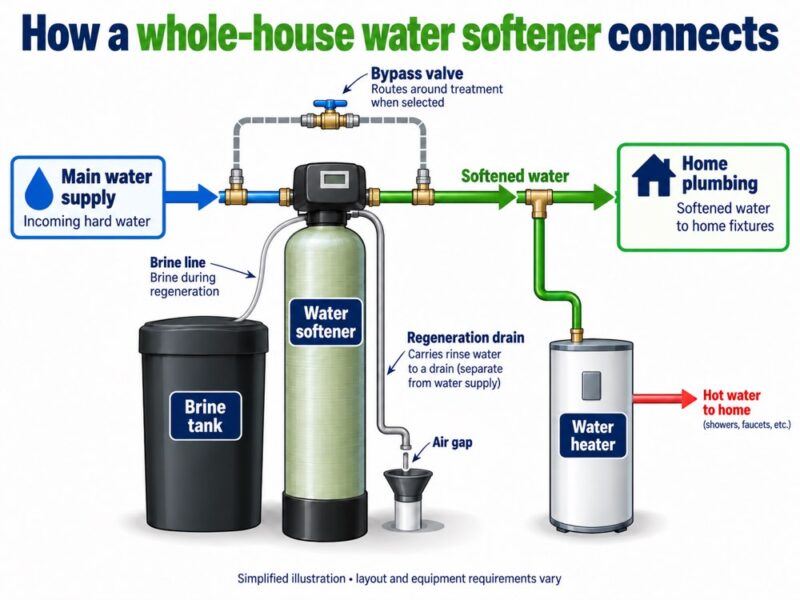
In an ion-exchange system, incoming hard water passes through resin media that exchanges hardness ions for other ions. Treated water then continues to the plumbing branches included in the installation. The equipment is sized and configured for the expected water conditions and demand.
Over time, the resin needs regeneration to restore its softening capacity. The brine tank holds the salt solution used during that cycle, and regeneration discharge is routed to an appropriate drain. The owner’s manual explains the model’s operating cycle, salt requirements, settings, and care.

Choosing an Installation Location
A whole-house water softener is typically connected where the incoming supply can be treated before water reaches the intended fixtures and water heater. The location is determined by the home’s plumbing route, not by choosing an empty corner first. Certain branches, such as outdoor water use, may be left untreated as part of the design.
- Main-line access: A suitable connection point and compatible pipework need to be identified.
- Space and clearance: Allow for the treatment equipment, brine tank where applicable, access to controls, and routine salt handling.
- Drainage: Regeneration discharge needs an appropriate drain arrangement, including the required air gap and any separate overflow provision.
- Power: Confirm whether the proposed equipment needs an outlet and what power supply it requires.
- Protection and access: The installation environment must meet the equipment’s requirements and allow the bypass to remain accessible.
The incoming main water line is the supply path, not the treatment equipment itself. If there is a suspected leak or damaged supply pipe, EJ’s main water line repair page explains that separate plumbing concern.
Existing Softener Loops and New Plumbing
Some homes already have a water softener loop: plumbing arranged to connect a treatment system to the incoming supply. A usable loop can change the scope of installation, but its presence does not confirm that the connections, location, drain, or available space suit the proposed equipment.
Without a suitable loop, additional water-softener plumbing may be needed. The plumber must establish how water flows through the home and which lines the installation will treat before connections are adapted. An existing bypass or old unit should also be reviewed rather than automatically reused.
A plumbing inspection can provide context when accessible supply piping or the overall layout needs evaluation. The installation plan should identify the actual work required before timing or cost is confirmed.
Illustrative equipment setup after installation. Settings depend on the selected system.
How EJ Plans a Water Softener Installation
The consultation starts with your concerns: scale on fixtures, spotting, soap residue, or another water-quality goal. Hardness should be distinguished from taste, odor, sediment, or drinking-water issues so that the equipment addresses the intended problem.
EJ reviews household water use, accessible plumbing, the incoming main, any existing loop, available installation space, drainage, and power requirements where applicable. Relevant hardness information and equipment specifications help guide the proposed capacity and configuration.
Bring any available water-quality information and details of equipment you already own or are considering. Ask which items are included in the installation proposal and confirm compatibility before purchasing a unit. No laboratory testing service or specific equipment brand is implied by the consultation.
Sizing a Whole-Home Water Softener
Capacity is about treatment demand and useful flow, not just the physical size of the tank. Occupancy, typical water use, measured or otherwise relevant hardness information, peak flow needs, regeneration settings, and the equipment configuration all influence selection.
A system should be evaluated for how the household actually uses water, including times when several fixtures operate together. An undersized or incorrectly configured unit may not meet expectations; choosing the largest advertised capacity without that information is not a complete design approach either.
A water softener installer should explain the basis for the proposed capacity, what parts of the home will receive treated water, and the expected ownership requirements. Specific grain capacities and settings should follow the assessment and equipment instructions.
Traditional Softening and Salt-Free Conditioning
Conventional Water Softener
An ion-exchange softener reduces hardness minerals using resin media and periodically regenerates. Salt and brine handling, discharge, controls, and care depend on the system design.
Salt-Free Water Conditioner
Products marketed as salt-free conditioners use different treatment approaches. They should not be assumed to remove calcium and magnesium in the same way as an ion-exchange softener. Review the product’s documented function rather than treating the names as interchangeable.
These terms explain different equipment categories, not a promise that EJ installs every type or brand. Confirm the proposed equipment and its installation requirements with EJ before making a purchase.
Water Softener vs. Water Filtration
Hardness, sediment, taste, odor, and drinking-water quality are different treatment goals. A conventional softener primarily addresses hardness. A filtration system may target other substances depending on the technology and its documented reduction claims. One does not automatically replace the other.
Some homes may need more than one treatment stage for separate goals, while others may only be concerned about hardness. Identify the concern first and review the equipment’s documented capabilities. The CDC overview of home water treatment explains why different methods serve different purposes.
If drinking-water quality is the concern, consider the source water and relevant water-quality information separately. Do not assume that softer-feeling water establishes contaminant removal or safety.
The Professional Installation Process
The exact work depends on the home and selected equipment. EJ’s installation plan should make the connection scope and setup responsibilities clear.
Review the supply connection, intended treated branches, equipment suitability, placement, and access.
Adapt appropriate connections and provide the bypass arrangement required for the system.
Install the treatment unit and any separate brine tank with compatible, supported plumbing.
Follow equipment instructions and applicable installation requirements for discharge, air gaps, overflow, and power where needed.
Restore water in accordance with the equipment instructions and inspect connections and relevant operation.
Configure the selected equipment appropriately and explain the bypass, controls, manual, and manufacturer-directed care.
Professional installation brings the plumbing connection, bypass, drainage, equipment placement, leak checks, and setup into one considered plan. It does not eliminate every possible plumbing problem or guarantee a particular appliance lifespan.
Installing a New Softener in Place of an Older Unit
Recurring equipment faults, leaking or corroded equipment, reduced resin performance, obsolete controls, limited parts availability, or changing household needs may prompt a homeowner to consider a new unit. Age alone does not establish that replacement is necessary; equipment faults and repair options should be evaluated through the manufacturer or an appropriate equipment service provider.
When a new installation is chosen, the old unit’s connections are only the starting point. The proposed softener’s dimensions, flow direction, bypass, drain requirements, available space, and setup may differ. EJ can review the plumbing for installation of the new equipment and explain any changes required.
Maintenance and Ownership After Installation
Follow the manufacturer’s instructions for the selected system. Depending on the equipment, ownership tasks may include maintaining appropriate salt levels, watching for salt bridging, monitoring for leaks, checking settings, and arranging specified cleaning or service. A change in water conditions or household use may also warrant reviewing the configuration.
Keep the manual and equipment information accessible. Ask where the bypass is located and how the manufacturer instructs you to use it. Do not change controls, add chemicals, or open equipment contrary to its instructions.
Water Softener Installation Cost Factors
An accurate proposal depends on the selected equipment and the work required at the home. Capacity, system type, an existing usable loop, main-line accessibility, plumbing modifications, bypass configuration, drain routing, power provisions, and equipment location all affect the scope.
Additional treatment equipment for separate water-quality goals can change the plan as well. Discuss what is included in the quote, which equipment is being provided, and any preparation or related work needed. An assessment is more useful than applying another home’s installation price to your property.
Local Plumbing Experience from EJ Home Services
EJ Home Services is based in Santa Clara and serves nearby Silicon Valley communities. Its published website highlights more than 20 years of experience, family ownership and operation, and contractor license number 826797.
For water softener installation, begin with a practical review of the water concerns, household needs, and plumbing arrangement. EJ’s existing scheduling and contact options make it straightforward to discuss the proposed work and confirm equipment compatibility and current availability.
What Local Customers Say About EJ
EJ Home Services has a 4.9 out of 5 Google rating from 3,884 reviews, checked October 28, 2026. These are company-wide reviews across EJ’s services, not reviews solely of water softener installation. Read reviews on Google.


Water Softener Installation FAQs
What does a water softener remove?
A conventional ion-exchange water softener primarily reduces hardness minerals, especially calcium and magnesium. It is not a universal filter or disinfection system. Claims about reducing other substances must be checked against the specific equipment’s documented capabilities.
How do I know if I have hard water?
White buildup around faucets or showerheads, spots on glassware, and soap residue can suggest hardness. Similar symptoms can have other causes. Use relevant utility information and appropriate hardness testing to establish the water conditions before selecting equipment; appearance alone is not a measurement.
Where is a whole-house water softener installed?
A whole-home softener is generally connected to the incoming water supply before the lines it is intended to treat, commonly upstream of the water heater. The location depends on the plumbing route, usable loop, space, drain access, power needs, and equipment protection. Some branches may remain untreated according to the installation design.
Do I need a plumber to install a water softener?
Installation can involve main-line plumbing, compatible fittings, a bypass, appropriate drainage and an air gap, equipment placement, and setup. A plumber can review the existing arrangement and complete suitable connections. Even a home with a softener loop needs an assessment of the proposed equipment and installation requirements.
What size water softener do I need?
Capacity depends on household water use, occupancy, relevant hardness information, required flow, regeneration settings, and equipment configuration. The physical size of a tank or household size alone does not establish the right capacity. An installation assessment should connect equipment selection to the actual home and water conditions.
Do water softeners need a drain?
Conventional regenerating water softeners generally need a suitable drain connection for regeneration discharge. Drain routing, an appropriate air gap, and any separate overflow requirements must follow the equipment instructions and applicable installation requirements. A nearby pipe is not automatically a suitable drain point.
Does a water softener need electricity?
Many softeners use electrical power for the controller or valve. Requirements vary with the selected equipment. The installation assessment should confirm the required power supply and whether a suitable outlet is available; not every model has the same requirements.
What is the difference between a water softener and water filtration?
Softening primarily addresses hardness minerals. A filtration system targets particular substances according to its treatment technology and documented reduction claims. Taste, odor, sediment, and drinking-water goals may require a different approach. One system does not automatically replace the other.
Can a new water softener use my existing connections?
Possibly, but the existing loop, pipe material, bypass, drain arrangement, available space, and proposed equipment need to be reviewed. Installing a new unit in place of an older one is not always a direct connection-for-connection swap. EJ can assess the plumbing for the proposed installation.
How often does a water softener need maintenance?
Follow the specific manufacturer’s instructions. Depending on the model, ownership tasks may include checking salt levels, watching for salt bridging, monitoring leaks, reviewing settings, and arranging recommended cleaning or service. Water use and conditions matter, so there is no universal maintenance interval for every system.
Is softened water safe to drink?
Softening alone does not establish drinking-water safety and does not make contaminated water safe. Drinking-water goals should be considered separately from hardness. Ask the equipment manufacturer about the system’s effect on the water, including sodium-related questions, and consult an appropriate health professional for individual dietary concerns.
Does EJ repair water softeners?
EJ’s water-softener offering is professional installation. For equipment faults, repairs, or ongoing equipment maintenance, use the manufacturer’s recommended support or an appropriate equipment service provider. Contact EJ when you are planning a new water-softener installation.

Request Service
Make Us Your Top Choice
 Fast Response Time
Plan Your Water Softener Installation
Tell EJ Home Services about your hard-water concerns, household needs, and any existing equipment or softener loop. The team can discuss installation planning and current scheduling in Santa Clara and surrounding areas.